
Toobit Exchange Review 2026: Fees, KYC, Security and Trading Features Lian Trader Academy.
Choosing a cryptocurrency exchange is rarely about finding the platform with the longest feature list. What matters is whether the fees are clear, the interface stays usable when markets move quickly, withdrawals are predictable, and the risk controls match the way you trade. Toobit gets several of those basics right, but it also has limitations that deserve a closer look.
In 2026, Toobit sits somewhere between a simple exchange for occasional spot buyers and a full trading terminal for active derivatives users. Standard spot trading currently carries no maker or taker fee, while futures, copy trading and automation tools give experienced users room to build more complex strategies. That combination is attractive, but it can also make the platform look easier than it really is. Zero trading fees do not remove market risk, liquidation risk or withdrawal costs.
This Toobit exchange review focuses on the questions a careful user should ask before depositing: What will trading actually cost? Can an account be used without KYC? How much can be withdrawn? What does Proof of Reserves prove, and what does it leave unanswered? Are the futures and copy-trading tools useful, or are they simply extra ways to take more risk?
Editorial note: The facts and limits in this article were checked in September 2026. Exchange rules can change, so always compare the numbers shown in your own account before trading. Cryptocurrency trading can result in substantial losses, and this article is not financial advice.
Toobit review: the short verdict
Review of Toobit may suit active traders who want zero trading commissions on standard spot pairs, access to perpetual futures and built-in copy-trading tools from one account. Its current documentation also states that users can trade spot and futures without completing identity verification, although verification may be requested for particular services or compliance checks.
It is not risk-free. Toobit is a centralized custodian, regional access can change, futures positions can be liquidated, and some newer or higher-risk tokens sit in an Assessment Zone with separate fees. Traders should verify eligibility, fees and withdrawal conditions inside their own account before depositing.
| Feature | Toobit in 2026 |
|---|---|
| Exchange type | Centralized cryptocurrency exchange |
| Launch period | Founded in 2022 |
| Main products | Spot, perpetual futures, copy trading, bots, P2P, Earn, DEX+ and TradFi products |
| Standard spot fees | 0% maker and 0% taker under the current fee policy |
| Base futures fees | 0.0200% maker and 0.0600% taker at VIP 0 |
| KYC for crypto trading | Not currently mandatory for direct spot and futures trading, subject to platform rules |
| Unverified withdrawal limit | Up to 5 BTC per 24 hours under the current published limits |
| Advanced verification limit | Up to 50 BTC per 24 hours |
| Mobile access | iOS, Android and Android APK |
What is Toobit?
Toobit is a centralized exchange founded in 2022. It provides an order-book marketplace for cryptocurrency trading and holds customer assets within exchange-controlled accounts.
Users can fund an account with crypto, place spot orders, trade derivatives, follow lead traders or use automated strategies.
The platform has expanded beyond a basic spot-and-futures exchange.
Its current product menu includes USDT- and USDC-settled perpetual contracts, demo trading, copy trading, grid and DCA bots, P2P trading, Earn products, DEX+ access and tokenized stock-futures products. Availability differs by region and may change over time.
What Toobit feels like to use
The first impression is that Toobit wants to keep the learning curve manageable without stripping away advanced tools.
main navigation separates spot, derivatives, copy trading and automated strategies, so a new user does not have to face every product on one screen.
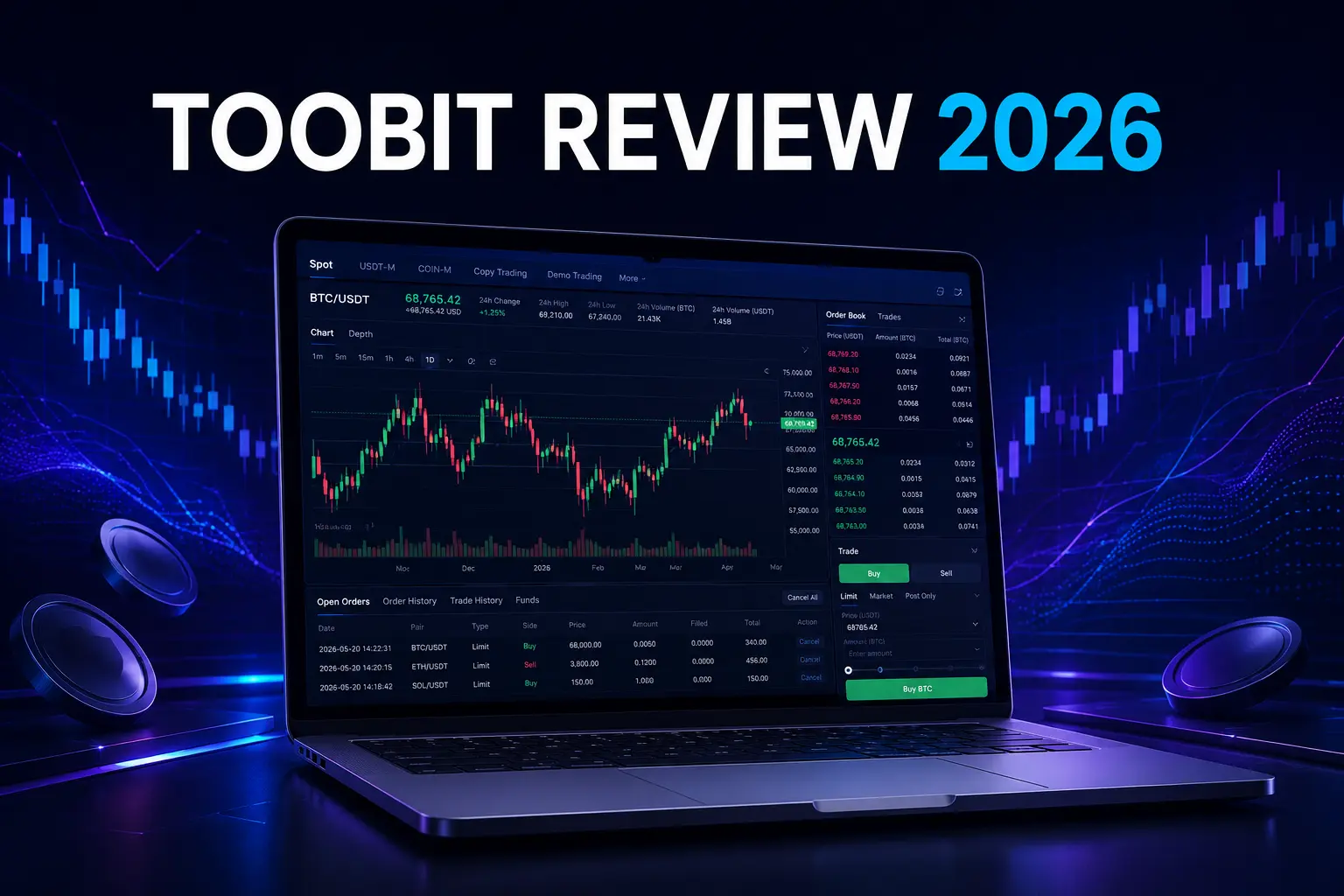
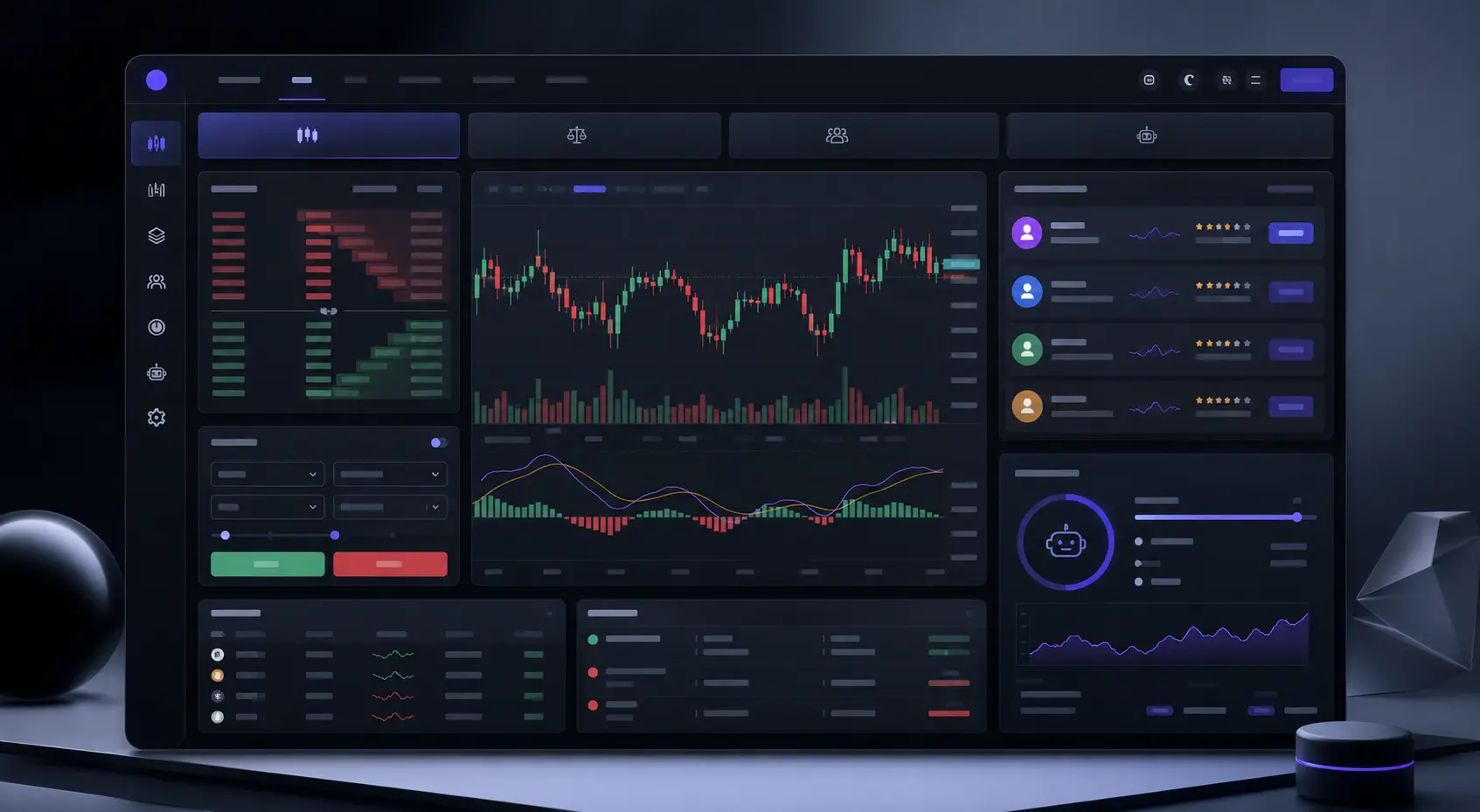
The visual style will feel familiar to anyone who has used a modern crypto exchange: a dark trading terminal, an order book, a central chart and an order panel on the side.
That familiarity is useful, but it should not be confused with simplicity.
market order can still execute at a worse price than expected in a fast market.
A futures position can still be liquidated.
A copied trader can change strategy after you begin following them.
The interface makes these actions convenient; it does not make them safe.
For occasional spot trades, most of the platform can be ignored.
Deposit the asset you intend to trade, choose the correct pair, decide between a limit and market order, and check the withdrawal network carefully. Active traders will spend more time adjusting chart layouts, watching funding rates and setting take-profit or stop-loss instructions. Keeping those two use cases separate makes Toobit less intimidating.
The practical benefit is that users can grow into the platform instead of immediately moving to another exchange. The downside is temptation: futures, bots and copy trading are always nearby. A good account setup begins with hiding or ignoring products you do not understand, then adding them only after testing with small amounts.
Who is Toobit best suited for?
Toobit is most relevant to three types of users:
- Frequent spot traders who can benefit from the current zero-fee policy on standard spot pairs.
- Derivatives traders who want perpetual futures, several order types, TradingView-based charts and risk-management controls in one interface.
- Users exploring automated tools such as copy trading, grid bots, DCA strategies or demo futures trading.
Beginners can use the simpler parts of the platform, but they should not interpret an easy interface as low risk. Leveraged futures and copied strategies can lose money quickly, particularly when leverage, volatile altcoins or thin order books are involved.
Toobit trading fees explained
Toobit published a revised fee structure on June 26, 2026. Under that schedule, standard spot trading is commission-free across VIP levels. At the base VIP 0 level, perpetual futures cost 0.0200% for maker orders and 0.0600% for taker orders. Higher VIP tiers reduce futures fees.
The zero-fee headline has an important exception. Spot pairs placed in the Assessment Zone follow a different fee table. At VIP 0, the published Assessment Zone rate is 0.0750% maker and 0.1000% taker. This distinction matters because newer or higher-risk assets may be assigned to that zone.
| Market at VIP 0 | Maker fee | Taker fee |
|---|---|---|
| Standard spot | 0.0000% | 0.0000% |
| Perpetual futures | 0.0200% | 0.0600% |
| Assessment Zone spot | 0.0750% | 0.1000% |
Trading commissions are not the only cost. Futures positions may incur periodic funding payments, instant orders may experience slippage, and crypto withdrawals carry network-dependent fees. Card purchases are processed through payment partners and can include provider or bank charges. Always check the final confirmation screen rather than relying on a review page.
The headline fee is not the whole cost
A zero trading fee sounds straightforward, but the final cost of a trade can still be higher than zero. The spread between the best buy and sell price matters, especially on smaller markets. Slippage matters when an order is large compared with available liquidity. Withdrawal fees matter when funds leave the exchange. Funding payments matter when a perpetual futures position remains open.
This is why the cheapest-looking option on a fee table is not always the cheapest in practice. A patient limit order on a liquid pair may cost very little. A rushed market order on a thin pair can lose more through price impact than it saves in commission. The sensible comparison is the amount you receive after the complete trade and withdrawal, not just the percentage printed beside maker and taker.
The Assessment Zone deserves special attention. Tokens placed there can have a different fee schedule and often carry higher volatility, thinner order books and greater delisting risk. Treat the zone as a warning label, not as a list of opportunities. If you trade one of those assets, reduce order size and check the fee displayed on the confirmation screen.
Futures users should also watch the difference between maker and taker behavior. A limit order that rests in the book may receive the maker rate, while an immediately executed order usually pays the taker rate. During volatile periods, funding and slippage can outweigh both. Frequent traders should review their monthly statement instead of estimating costs from a single advertised rate.
Does Toobit require KYC?
According to Toobit’s current KYC documentation, identity verification is not mandatory for users who directly trade spot or futures with cryptocurrency. An unverified registered account has a published withdrawal limit of up to 5 BTC per 24 hours. Advanced verification raises that limit to 50 BTC per 24 hours.
KYC can still become necessary. Buying crypto with a credit or debit card requires verification, and third-party payment processors can impose their own checks. Toobit may also request identity information for compliance, account recovery or risk-control purposes. “No mandatory KYC for trading” should never be interpreted as a guarantee that verification will never be requested.
| Verification level | Published 24-hour withdrawal limit | Fiat purchase access |
|---|---|---|
| Registration only | 5 BTC | Not available |
| Basic verification | 5 BTC | Available, subject to provider rules |
| Advanced verification | 50 BTC | Available, subject to provider rules |
These limits are platform-wide maximums, not promises that every withdrawal will be processed immediately. Security reviews, local regulations and blockchain conditions can cause delays. Verify the current limit displayed in your own account before planning a large transfer.
Supported and restricted countries
Toobit markets itself as a global platform, but it does not offer every service in every jurisdiction. The current Terms of Use identify multiple prohibited or restricted regions, while card-purchase availability has a separate regional list. These policies can change in response to sanctions, licensing rules, payment-provider requirements or internal risk decisions.
Before registering, check the latest eligibility notice shown by Toobit and make sure using the service is permitted where you live. Do not use a VPN or inaccurate identity information to bypass a restriction; that can lead to account limitations or difficulties withdrawing funds.
Liquidity, execution and order types
Order execution deserves more attention than it usually receives in exchange reviews. On a deep BTC or ETH market, a small order may fill close to the price shown on screen. On a newly listed token, the gap between bids and asks can be much wider. That gap becomes an immediate cost if you enter and exit quickly.
Limit orders give you more control because you choose the maximum price you will pay or the minimum price you will accept. Market orders prioritize speed and accept the best available prices in the book. Stop orders can help manage an exit, but they are triggers rather than guarantees; a sharp move can still produce slippage.
Before placing a meaningful order, look at the order book and recent trade history rather than relying only on the last traded price. Split an unusually large order when appropriate, and avoid assuming that the liquidity visible at one moment will remain there. These habits matter on every exchange, including Toobit.
Demo trading can be useful for learning where controls are located, especially before using perpetual contracts. It cannot reproduce the emotional pressure, slippage or liquidity of a live position, but it is still a better starting point than learning with borrowed exposure.
Spot trading on Toobit
The spot interface provides the familiar components of a centralized exchange: an order book, price chart, recent trades, available balance and order-entry panel. Market orders prioritize immediate execution, while limit orders let the trader choose a price. A limit order is not guaranteed to fill.
Zero standard spot commissions can be useful for frequent rebalancing, but traders should still evaluate liquidity and spread. A nominal 0% fee does not eliminate the cost of buying above or selling below the mid-market price. This is particularly relevant for newly listed or lower-volume assets.
Toobit futures and risk controls
Toobit supports perpetual futures settled in assets such as USDT and USDC. Traders can choose margin modes, set leverage, place market or limit orders and add take-profit and stop-loss instructions. The platform also offers demo trading, allowing users to practise with a virtual balance before risking real capital.
Leverage limits vary by contract and product. Higher leverage reduces the amount of adverse price movement needed to liquidate a position. New traders should start with demo mode, use low leverage if they later trade with real funds and treat a stop-loss as a risk tool rather than a guarantee against slippage.
Funding payments are separate from trading commissions and can be paid or received depending on the contract and market conditions. A position held for longer periods may accumulate several funding settlements.
Copy trading and trading bots
Copy trading automatically mirrors eligible positions from a selected lead trader. Toobit displays performance information to help users compare lead traders, but historical returns do not predict future results. A strategy with an impressive short record may be using excessive leverage or carrying hidden drawdown risk.
Before copying a trader, examine maximum drawdown, trading history, leverage, position concentration and the number of market cycles covered. Set a personal loss limit and avoid committing the entire account balance to one lead trader.
Toobit’s grid and DCA bots automate predefined rules. Automation can improve discipline, but a bot does not understand every market regime. Grid strategies can accumulate losses during strong one-way moves, and DCA does not make a declining asset fundamentally sound.

Security and Proof of Reserves
Toobit publishes a Proof-of-Reserves portal using a Merkle-based verification process. Its August 1, 2026 snapshot reported reserve ratios above 100% for major assets, including 107% for BTC, 108% for ETH, 102% for USDC and 104% for USDT. Users can check whether their balance was included in a reserve report.
This is a useful transparency measure, but Proof of Reserves has limits. It does not by itself prove the full quality of corporate governance, reveal every off-chain liability or remove custody and operational risk. Exchange balances should be limited to the amount needed for trading; long-term holdings may be safer in a properly secured self-custody wallet when the user understands private-key management.
Account-level precautions remain essential:
- Use a unique password that is not reused on email or other exchanges.
- Enable an authenticator app instead of relying only on SMS.
- Set an anti-phishing code and withdrawal security controls where available.
- Verify the domain before logging in and ignore unsolicited support messages.
- Whitelist withdrawal addresses if the account provides that feature.
- Make a small test withdrawal before transferring a large balance.
Customer support and account recovery
Support quality is difficult to judge from a feature list because the real test comes when a deposit is delayed, a withdrawal enters review or an account is locked. Toobit provides help-center material and account support channels, but response time can vary with demand and the complexity of a case. Keep screenshots, transaction hashes and exact timestamps before opening a ticket. A clear first message usually prevents several rounds of unnecessary questions.
Account recovery is another reason to complete security setup before depositing. Use an email address you control long term, store backup codes offline and avoid using the same password anywhere else. If you lose both email access and two-factor authentication, recovery may require additional checks even when normal trading did not require KYC.
Never trust a person who contacts you first and claims to be Toobit support. Legitimate support should not ask for a password, a two-factor code or a wallet seed phrase. Open support from inside the exchange website or app, and compare the case number with the one visible in your account.
How to create a Toobit account
- Open the registration page using the button below and confirm that the domain is Toobit.com.
- Choose email or mobile registration where available.
- Create a long, unique password and complete the verification code sent to you.
- Open the account security settings immediately after signing in.
- Enable two-factor authentication before making a deposit.
- Check your country eligibility, KYC level and withdrawal limit inside the account.
Promotions and welcome rewards are conditional. A displayed reward is not guaranteed merely for creating an account; deposit size, trading volume, region, campaign registration and deadlines may apply. Read the campaign rules before depositing for a bonus.
Deposits and withdrawals
Crypto deposits begin by selecting an asset and a supported blockchain network. The network selected on Toobit must exactly match the withdrawal network used by the sending wallet. Some assets also require a memo or destination tag. Sending through an unsupported network or omitting a required memo can result in permanent loss.
To withdraw, select the asset, network and destination address, then review the amount and fee before confirming the security checks. Withdrawal fees vary by asset and network and are shown in the withdrawal interface. Blockchain congestion and account-security reviews can affect processing time.
Toobit mobile app
Toobit provides apps for iOS and Android, along with an Android APK option. The mobile app supports account management, charts, spot and futures trading, deposits, withdrawals and other platform features. Download only through Toobit’s own website or a verified app-store listing. Avoid APK files distributed through messages or unofficial websites.
What Toobit could improve
The platform’s breadth is both a strength and a weakness. New products make Toobit competitive, but they also create a busier experience and more places for inexperienced traders to take risks they do not fully understand. A clearer beginner mode that hides leverage, bots and promotional modules would make the first week easier.
Regional eligibility could also be communicated more directly. Users should not have to compare several policy pages to understand whether registration, card purchases, P2P trading and derivatives are all available in the same country. A single country-specific availability page inside the account would reduce uncertainty.
Proof of Reserves is useful, but reserve ratios alone do not answer every question about an exchange’s financial condition. More context about liabilities, custody arrangements and how often wallet ownership is independently checked would make the transparency section stronger.
Finally, zero-fee spot trading should remain easy to verify at the order-confirmation stage. If a pair belongs to a different fee zone, the exception should be impossible to miss. Clear warnings are especially important for new listings where volatility and spreads may already be elevated.
Advantages of Toobit
- Zero maker and taker fees on standard spot pairs under the current 2026 policy.
- Competitive base futures fees and lower rates for qualifying VIP users.
- Spot, futures, copy trading and automated strategies in one account.
- Crypto spot and futures trading currently available without mandatory KYC for eligible users.
- Published Proof of Reserves with user-verification tools.
- Demo futures environment for practising before using real funds.
- Web, iOS, Android and APK access.
Disadvantages and risks
- Toobit is younger than several established global exchanges.
- Zero spot fees do not apply to Assessment Zone pairs.
- Regional eligibility and individual services can change.
- KYC may still be requested for fiat purchases, compliance or account recovery.
- Withdrawal and funding costs remain even when spot commissions are zero.
- Copy trading and bots can create losses; neither provides guaranteed returns.
- Centralized custody exposes users to platform, operational and counterparty risk.
- Leveraged futures can liquidate an account rapidly.
A sensible way to test Toobit
You do not need to decide whether Toobit will become your main exchange on the first day. A safer evaluation is a short, controlled test. Create the account, secure it, review the limits shown for your region and make one small crypto deposit. Place a modest spot trade on a liquid pair, then withdraw a small amount back to a wallet you control.
- Confirm the website address and secure the account with two-factor authentication.
- Check country eligibility, KYC status and the withdrawal limit shown in the account.
- Deposit only a small test amount on a network you understand.
- Use a liquid spot pair and compare the preview with the final execution price.
- Make a test withdrawal and record the fee and processing time.
- Only after that test, decide whether advanced products are necessary.
This process will tell you more about practical suitability than any ranking table. It checks the full cycle from deposit to withdrawal, which is the part that matters most when real funds are involved.
Is Toobit safe and worth using in 2026?
Toobit has several features that make it competitive in 2026: zero-fee standard spot trading, a full derivatives interface, non-mandatory KYC for eligible crypto traders and a visible Proof-of-Reserves system. Those strengths make it worth evaluating, particularly for active traders who understand the difference between standard markets and the Assessment Zone.
However, “worth evaluating” is not the same as “risk-free.” Toobit remains a centralized exchange, policies can change and derivatives are inherently risky. A cautious approach is to confirm eligibility, secure the account, deposit a small amount, test a withdrawal and increase exposure only after understanding the platform.
Frequently asked questions Toobit Exchange Review 2026: Fees, KYC, Security and Trading Features
Is Toobit a legitimate cryptocurrency exchange?
Toobit is an operating centralized exchange founded in 2022 and provides spot, futures and other crypto services. Legitimacy should not be treated as a guarantee of safety. Review its current legal terms, security reports, reserve data and availability in your jurisdiction before funding an account.
Does Toobit require KYC in 2026?
Toobit’s current support documentation says direct spot and futures trading does not require mandatory identity verification for eligible users. KYC is required for card purchases and may be requested for compliance, account recovery or risk-control checks.
What is the Toobit withdrawal limit without KYC?
The currently published limit for a registered but unverified account is 5 BTC per 24 hours. Advanced verification raises the published limit to 50 BTC. Always check the live limit shown in your own account.
Is Toobit spot trading really free?
Standard spot markets currently have 0% maker and 0% taker fees. Assessment Zone spot pairs are excluded and use a separate fee schedule. Spreads, slippage and withdrawal fees can still apply.
What are Toobit’s futures fees?
At VIP 0, the June 2026 schedule lists a 0.0200% maker fee and a 0.0600% taker fee. VIP rates and platform policies can change, so check the official fee page before trading.
Can beginners use Toobit?
Beginners can use spot markets and demo trading, but should avoid high leverage until they understand liquidation, funding, margin modes and order execution. Copy trading is not a substitute for risk management.
Does Toobit have an app?
Yes. Toobit provides iOS and Android apps and an Android APK through its official download page.
Can Toobit be used in every country?
No. Toobit’s Terms of Use restrict access in a number of jurisdictions, and the availability of card purchases or other services may have separate limitations. Check the latest terms and local law before registering.
Should I keep long-term crypto holdings on Toobit?
An exchange account is convenient for active trading, but it introduces custody and counterparty risk. Consider limiting exchange balances to trading needs and use secure self-custody for long-term holdings if you understand how to protect private keys and recovery phrases.
Last reviewed: September 2026. Fees, verification rules, regional availability and product terms can change without notice.